Most companies treat shadow AI as a problem to shut down.
Employees pasting work into ChatGPT. Someone on the finance team running their own prompts.
The instinct is to lock it down. Security risk. Data risk. Off-policy.
That instinct misreads what is actually happening.
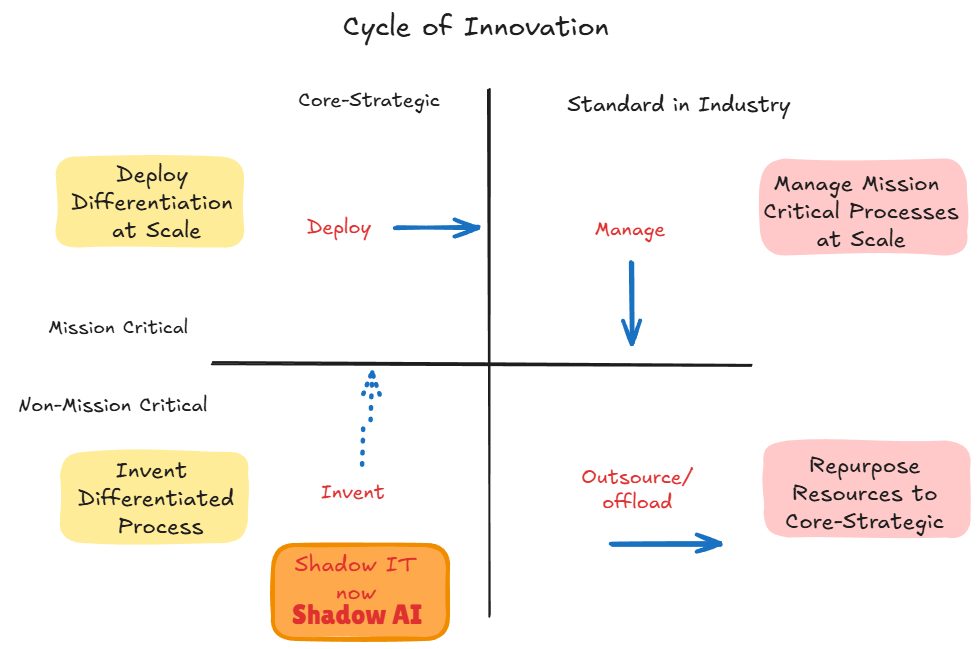
Twenty years ago, Geoffrey Moore mapped how companies innovate in his book Dealing with Darwin. One of his quadrants is “Invent”, the non-mission-critical, non-core corner where new ideas get tried before anyone trusts them. Historically this is where a power user built a spreadsheet that solved a real problem, and the good ones quietly spread until they became the way the team worked.
Shadow AI is lighting up that quadrant again on steroids.
It is not a breach. It is your most motivated people solving problems faster than your rollout plan can. They are doing unsanctioned experimentation on real work. That is exactly what the Invent quadrant is for.
In the old IT world, there was an informal path upward. The good spreadsheet got noticed. Someone scaled and secured it properly. It became a supported tool. The business had a way, however messy, to promote what worked from the corner into the core.
Most companies have no such path for AI.
The wins happen in the shadows and stay there. The person who cut a three-hour task to twenty minutes has no route to make that the standard.
Structuring that path is today’s problem. Does your company have one yet?